Back
patrimoine culturel
The Priory and its Formal French Garden
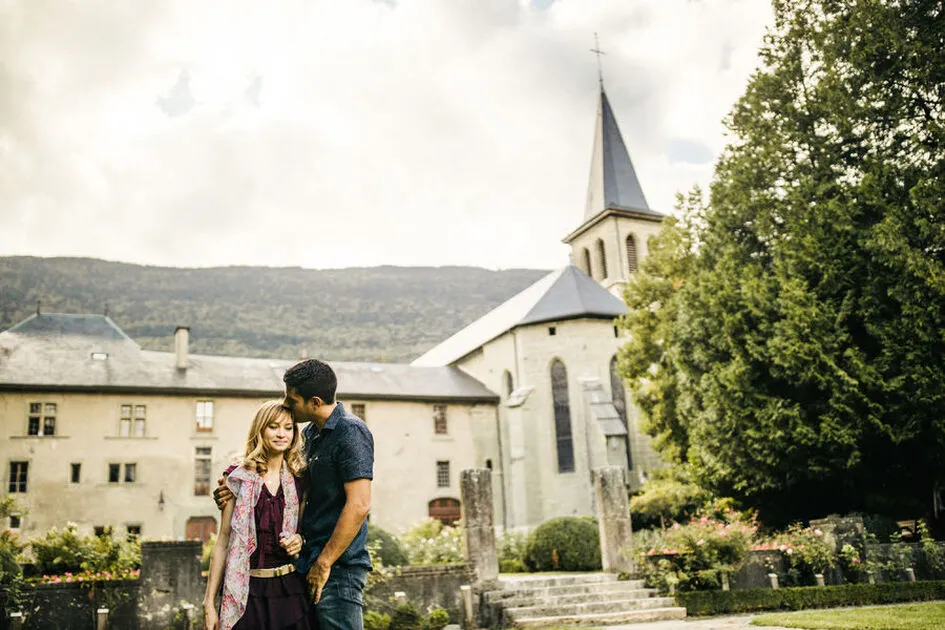
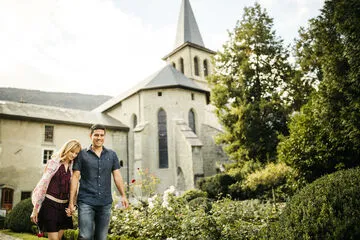


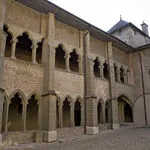
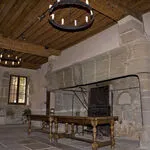
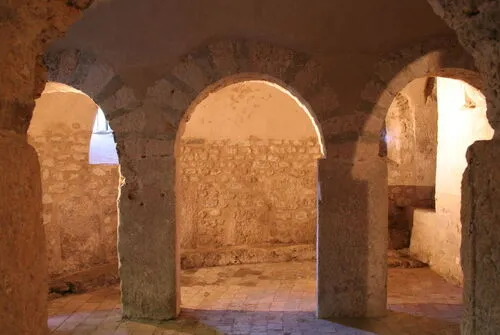
This Cluniac Priory founded in the 11th century consists of a Gothic church, a Romanesque crypt and monastic buildings and gardens arranged around a long avenue.
Guided tours only.
Description
The Priory was built around the year 1030 following a prophetic dream by Odilon, the fifth abbot of the Great Abbey of Cluny.
According to legend, Odilon stopped at Le Bourget-du-Lac because he had a high fever. One night, while delirious, he reportedly saw the Count of Savoy and Saint Maurice planting a cross. The saint then touched him, and the next day Odilon was cured. Interpreting this as a divine sign, he decided to build a priory dedicated to Saint Maurice to thank him.
The rooms are arranged around the cloister, the heart of daily life. On one side are the domestic rooms—the kitchen, refectory, and pantry—and on the other, the spiritual rooms—the chapter house and chapel. Seven monks lived permanently at the priory.
The refectory is the first room you enter. This is where the monks ate their meals.
The room is spacious because the monks welcomed the needy and pilgrims. You can also admire two neo-Gothic sideboards.
The adjoining room, the kitchen, features a beautiful 15th-century fireplace made of molasse, a local stone. At the center of this fireplace is the coat of arms of the de Luyrieux family, two of whose members served as priors and contributed to the priory’s splendor in the 15th century.
The library is a feast for the eyes with its Cordoba leather ceiling. Converted into a library in the early 20th century by the Duchess of Choiseul, the function of this room during the monks’ time remains unknown. Perhaps it served as a scriptorium (a place where manuscripts were copied).
The Saint Claude Chapel, located beneath the cloister gallery, appears deserted today. In the days when the monks occupied the priory, the altar faced away from the gardens and featured a 15th-century painting on wood.
Via a small spiral staircase, the House of Savoy accessed a box reserved for them. This box has an opening that looks out onto the church’s choir.
The House of Savoy lived at the priory until 1248, when Thomas II’s castle was built on the lakeshore.
The next room is known as the chapter house. It was here that the monks gathered daily to discuss monastic life.
In this room, you can admire a bronze sculpture depicting the Duchess of Choiseul. She purchased the priory around 1912 and lived there until 1939. The town purchased the buildings in 1952.
Before her, an art lover from Chambéry, Mr. Barut, had had part of the premises designated as a “Historic Monument.”
The Cluniac monks left the priory in 1582. Jesuits took their place until 1773, followed by the Franciscans of Chambéry until the French Revolution, when the priory was sold as national property. A notary, followed by farmers, occupied the premises until Jean Barut purchased it.
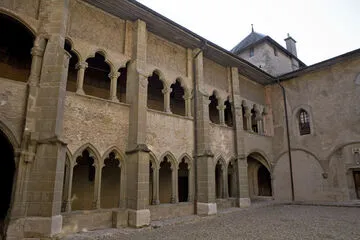
The cloister, around which the rooms—and indeed monastic life—are arranged, has several distinctive features.
First of all, it is incomplete, as only one side features a gallery. Apparently, it was never finished.
The current gallery dates from the 15th century. It was commissioned by Oddon de Luyrieux, the prior, and built in the Gothic style.
Another distinctive feature: the upper gallery is Romanesque in style, while the lower gallery is Gothic—yet in most buildings, the older parts are typically found at the base of the structure. The upper gallery was built in the 13th century and is part of the former cloister. From a path, you can admire the French-style gardens with their axial perspective.
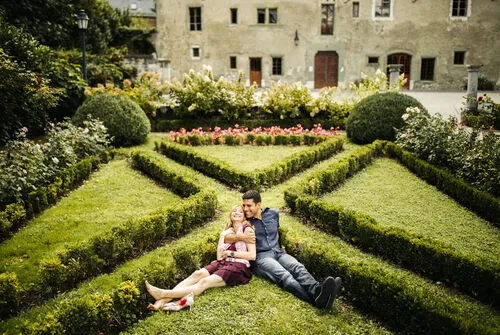
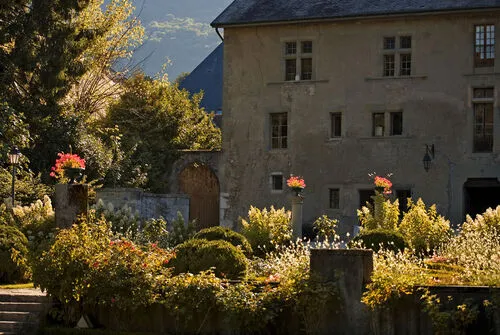
The French-style gardens were originally a vegetable garden and an orchard to provide for the monastery’s needs. In the early 20th century, the Duchess of Choiseul transformed them into a French-style ornamental garden featuring pruned yew trees and several rare species. Two sculptures by Jacques Coquillay catch your eye along the axis.
The town of Bourget-du-Lac has joined the network of Cluniac sites, linking the priory to the Council of Europe’s major cultural route.
It is currently the only one of its kind in Savoie.
Payment methods
-
 Check
-
 Cash
Opening period
Priory only open for group guided tours, by reservation only
Individual guided tours available in summer.
Spoken languages
-
 English
-
 French
Location
Pets
Pets allowed : No


-
Le Bourget-du-Lac
 patrimoine culturel
Gardens of the Priory
-
Le Bourget-du-Lac
 patrimoine culturel
Church of Saint Laurent
-
Le Bourget-du-Lac
 equipement
Aymon Trail
-
Agenda Aix-les-Bains
Bourget du Lac Priory
- Guided tour
Wednesday 18 November
-
Agenda Aix-les-Bains
The Priory and the Château Thomas II
- Guided tour
Wednesday 18 November